Smart Enterprise Password Management for Safe AutoLogon® clients
Safe AutoLogon Password Server, SALPS, centrally manages automatic-logon credentials across hundreds or thousands of Windows computers.
Using its patented algorithm, SALPS synchronizes password changes with Active Directory, securely generates and rotates passwords, and delivers the current credential to Safe AutoLogon clients at startup, and keeps remote or long-offline computers synchronized without requiring administrators to touch each endpoint




Designed for Large Endpoint Environments
SALPS includes centralized grouping, wildcard searching, multithreaded endpoint operations, and optimized replication for organizations managing hundreds or thousands of Safe AutoLogon clients.
Prove It in Your Own Environment
Evaluate SALPS using your own test environment with two SALPS servers and two Safe AutoLogon clients. Test automatic logon, password rotation, server redundancy, remote configuration and long-offline client recovery.
Manages the Entire Safe AutoLogon Credential Lifecycle
SALPS does more than store passwords in one location. It manages the complete lifecycle of automatic-logon credentials:
- Generate or enter credentials centrally
- Synchronize password changes with Active Directory
- Assign accounts to individual computers or groups
- Deliver the current credential at startup
- Recover computers that missed previous password changes
- Remotely install and configure Safe AutoLogon
- Query endpoint status and operating-system information
- Operate with multiple SALPS servers for availability
256-bit AES Encryption and Credential Handling
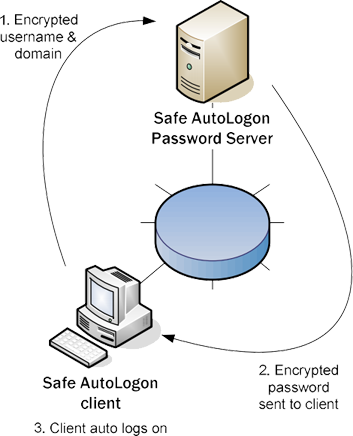
Credentials are protected in the SALPS database and while being transmitted between SALPS servers and Safe AutoLogon clients using AES-256 encryption.
What is encrypted with SALPS? Everything. The database, the data in the database, and the encryption of data in network packets to and from the SALPS servers.
Centralized Safe AutoLogon Endpoint Management
Discover computers, check client and operating-system status, remotely install Safe AutoLogon, distribute configurations and manage assigned credentials from one console.
Remote installation, client status, operating system reporting, bulk username -> client sending, and remote configuration deployment
The End of Clear Text Passwords
Say goodbye to storing clear texts in the Registry for automatic logons and software that claims to store password encrypted "safely" in the Windows LSA. These are easily cracked.
When used with SALPS, the Safe AutoLogon client retrieves its current assigned credentials through a centrally managed and encrypted process.
Administrators can rotate a domain account password centrally without manually visiting every assigned workstation. The next time an authorized Safe AutoLogon client starts and contacts SALPS, it receives the current credential.
How SALPS Supports Safe Autologon
1. Defines account password and rotation policy
Add an Active Directory account to SALPS, assign it to the appropriate computers and configure whether its password will be changed manually or generated automatically on a schedule.
2. Synchronizes account passwords with Active Directory
When a password is changed through SALPS, SALPS updates the corresponding Active Directory account. SALPS can generate new passwords and synchronize password changes with Active Directory according to the configured schedule.
3. High availability with multiple SALPS servers
For production environments, WM Software recommends at least two SALPS servers. Safe AutoLogon clients contact an available SALPS server when retrieving credentials.
4. Retrieves logon credentials for Safe AutoLogon clients
When Windows starts, Safe AutoLogon contacts an available SALPS server and securely obtains the current credential assigned to that computer.
5. Monitors and manages endpoints centrally
Administrators can query client status, remotely install Safe AutoLogon and send complete Safe AutoLogon configuration files from the SALPS console..
6. Recovers long-offline computers automatically
A computer that missed one or more password rotations receives the current credential when it reconnects. Administrators do not need to replay each missed password change.
Credential Continuity
Computers that remain offline through multiple password changes do not need every missed password. When they return, Safe AutoLogon securely retrieves the current credential from an available SALPS server.
Automated Password Rotation
Generate strong passwords automatically and rotate them on a configurable schedule. SALPS updates the corresponding Active Directory account and makes the current credential available to assigned Safe AutoLogon clients.
Active Directory Synchronization
Change an account password through SALPS and keep Active Directory and assigned Safe AutoLogon clients synchronized through one managed workflow.
Resilient Startup
Safe AutoLogon can locate multiple SALPS servers, wait for slow network initialization and report clearly when a credential server or assigned username is unavailable. Clients support DNS discovery, configurable waits for network or SALPS availability, and startup notifications when no server or username is available
Deploy On-Premises or in an Azure VM
SALPS runs on Windows Server and may be deployed on a physical server, an on-premises virtual machine or a supported Windows Server virtual machine in Microsoft Azure.
SALPS is listed in Microsoft Azure Marketplace and Microsoft AppSource.

System Requirements
Safe AutoLogon Password Server (SALPS) software is licensed per operating system, either running in a VM or on a physical server. A minimum of one SALPS license is required for automating logons in synch with Active Directory. Two or more SALPS licenses are recommended for failover purposes. The SALPS software needs to be installed on a Windows Server that is running 24x7. A single SALPS deployment supports thousands of Safe AutoLogon clients.
 |
Hardware |
| Same as the operating system requirements. Usage: 25MB RAM; 50MB drive space |
 |
Operating Systems | |
| Windows 2016 |
Windows 2019 |
Windows 2022 |
Windows 2025 |
 |
|
|
|